Rauli wrote a journal on his 12 days of attending and handing out (3,000!) Climate Gamble books during COP21 with Janne.
The style is somewhat personal, so read at your own risk. Needless to say, it was a highly interesting trip, going from being teargassed by the riot police to meeting Jim Hansen to speaking at what amounted the first ever COP discussion panel on nuclear and climate that went well and without disturbances.
Finnish Ecomodernists at a Climate March, 29.11.15. Photo by Meri Tuuli Lauranto.
Greetings from Paris! Despite considerable logistical difficulties, we’ve managed to hand out nearly 2000 copies of Climate Gamble to interested people around COP21 climate conference; many thanks to everyone who’ve supported our campaign so far.
As expected, there has been some criticism. Many people sincerely believe nuclear power has unacceptable risks or drawbacks, or that nuclear industry is part of the problem rather than the solution.
This line of reasoning is entirely valid and supported by strong arguments. Nuclear power is far from the problem-free solution it is sometimes portrayed as, and nuclear industry hasn’t been exactly the shining paragon of good corporate citizenship. While there are some bad arguments against nuclear power (CO2 emissions, for example: lifecycle emissions are broadly similar to lifecycle emissions of wind power), there are also good arguments and very smart, sincere people behind the anti-nuclear position.
We obviously disagree with some of the conclusions that are made from the same premises. Our chief disagreement is in whether we need nuclear power or not, and whether the benefits outweigh the risks. We believe it may be possible to power the global society with renewables alone, but we are afraid that without nuclear, we are taking more risks in the climate fight than we should take. This is not an isolated opinion: among others, some very influential climate scientists are saying the exact same things. Furthermore, reviews of non-nuclear climate mitigation scenarios find consistently that they are dependent on a large set of hopes and assumptions becoming reality.
While it is far from certain that we can do the job even with nuclear, the amount of lucky breaks humanity needs is almost certainly smaller if we allow ourselves to use all the options. If we fail to mitigate climate change while denouncing nuclear power, our descendants – if there are any – will forever wonder whether the crisis might have been averted or at least its worst impacts mitigated if nuclear energy had not been opposed so strenuously. We think we owe it to future generations human and nonhuman to at least keep an open mind regarding potential solutions to one of humanity’s greatest challenges so far.
But even more important, in my opinion, is that we allow those who are concerned about our common home to join forces. It seems highly improbable much progress will be made if those concerned about the environment or social justice devote one hand to fighting those who agree with the broad goals, but disagree over some specifics of the strategy. This is one of the key reasons why I’m involved in the fledgling Ecomodernist movement: I want to help provide a platform for those who have felt excluded from traditional environmental activism, because they happen to be in some disagreement with some of the values and premises of the traditional environmentalism.
This year’s Climate March was advertised with the words “if we want to change everything, we need everybody.” There is much truth in these words. If the label “environmental activist,” for example, is reserved for only those who subscribe to the tenets of the traditional movement, it is painfully clear we will fail. In the timeframe we have available at least (less than 35 years), there are simply no prospects whatsoever for “converting” the required majority of world’s population to accept a set of values and premises that are highly Western-centric, Leftist, and make some very strong assumptions about particular technologies for example.
Instead of hoping a mass conversion and adoption of traditional environmental values hook, line and sinker, I believe environmental activists need to reach out to those who’ve been excluded so far. This year, the Ecomodernist movement brought about dozen people to march for climate in Helsinki. Only a dozen, because we organised our participation on a very short notice; but dozens more indicated they would like to participate in the future. With one or two exceptions, not one of them had ever demonstrated for the environment: most hadn’t ever been in a demonstration of any kind.
Perhaps you believe the environmental movement can do without these people. Perhaps you even believe it should do without. If you think so, I think you are wrong. In the aftermath, there were obviously some who questioned why we carried banners supporting low-carbon energy – nuclear power. But the wisest comment came from a self-described opponent of nuclear power: this is a time when we should concentrate on what we have in common, rather than focusing on what separates us.
I heartily agree. These words, among others, have already influenced my thinking. In the past, I’ve been highly critical of traditional environmentalists and sometimes attacked them rather viciously for being “dumb” in their opposition to nuclear power, or in their support for highly destructive practices such as widespread bioenergy use just because it’s nominally “renewable.” I apologise for being such a jerk and try to rein it in, preferably stopping it entirely. We really do need to focus on what we have in common: our concern for our common home and those whose home it is.
It is true, as several critics have pointed out, that many “new” environmentalists have been highly aggressive towards existing environmentalism and environmentalists. I’ve been one of those aggressive people, after all. I think this needs to stop, if we want to change things rather than flaunt ourselves to the small circle of like-minded people. There is no joy nor hope in trying to convert traditional environmentalists to wholeheartedly support nuclear power, for example: the goal is just as futile as the goal of converting the majority of the world to the values of traditional environmentalism. For the most part, all such efforts will achieve is a pat in the back from those who already agree.
Instead of scoring points among the already converted, I think ecomodernism and future environmental movements, which I believe will emerge, should focus on those who care but haven’t been able to work within existing platforms to channel their energy towards the overall goal: of building a better world for everyone.
An aside about heresies
Nevertheless, I think it is instructive to try to think why there have been so vicious infighting between people who call themselves environmentalists. In Monty Python’s fantastic Life of Brian, there is a brilliant scene where hapless Brian mistakes the activists of anti-Roman People’s Front of Judea for the activists of Judean People’s Front. As explained by Reg, the leader of the People’s Front,
The only people we hate more than the Romans are the fucking Judean People’s Front.
The scene is hilarious because it is firmly based in reality. We humans seem to have a tendency to reserve most scorn not for those who disagree with us in everything, but for those with who we have more in common. The one who disagrees with us in everything is simply an implacable, inhuman enemy, not worth a dialogue. He must only be destroyed; once every enemy is destroyed, a Final Victory will occur for those who share the True Faith.
But the one who agrees with many things yet disagrees on some points is worse: he is a heretic, or a traitor. Heretics may be reconverted to the True Faith and their souls saved; traitors have a reserved seat in Hell.
As you may have guessed already, much of this dichotomy may stem from the Western cultural tradition that is heavily influenced by Abrahamic religions. These religions have clearly defined “us” against “them” and very black and white visions of “good” versus “evil.” (Thanks to the thoughtful student of Hindu environmental activism for pointing this out to me. If someone ever again says there’s no benefit from studying different cultures, I’m going to be quite angry.)
It just may be that such deep, unconscious, culturally embedded frameworks of heretics and traitors may explain some reasons why many environmental activists in the West at least have lately been bashing each other. I, too, shared this worldview: the traditional environmentalists are so much like me in almost every respect that I have hoped to convert them to the One True Faith of atomic powered future. In effect, I’ve been trying to persuade what I see as heretics in order to save their souls. Likewise, many have tried to convert me to renouncing the Atomic Devil.
And when these efforts fail as they usually do, we’re billed as traitors and enemies to the movement, to be excommunicated from the presence of the faithful. To many, it seems to be hard to accept one may be very much for environmental and social justice while still supporting nuclear power. To others, not supporting nuclear power at this juncture seems the very epitome of stupidity or worse. Witness, for example, the regularly surfacing insinuations that those who disagree must be in the pay of some nefarious organisations. It is probably far easier to believe the disagreement stems from selfish motives than to face the fact that there may be persons who agree with you on most but not all things.
That said, there are also legitimate corporate lobbyists interspersed among both “new” and “traditional” environmentalism. There really are people employed by the nuclear industry PR departments, for example. Likewise, the traditional environmental movement works closely – in my opinion, somewhat too closely – with renewable energy industries and their lobbying groups, taking their claims a bit too uncritically. In accordance with the rest of this article, I think we need to be in speaking terms with these lobbyists as well: based on my experience, most of them are decent people who want to do good. But we must not let them define what we want to do. Personally, I believe one reason to support the inclusion of nuclear power within climate change efforts is to keep the renewable industry on their toes: if we exclude potential competition, we increase the risk that these very large and powerful industries may capture the climate mitigation movement entirely. There are a lot of good people in the renewable industries; but they are still companies, still obliged to make a profit, with all the potential consequences this brings in our current form of economic system.
External costs of different electricity generation technologies in the European Union (2012). Adapted from Ecofys (2014): Subsidies and costs of EU energy, figure 3-8 and Annex 1-3, Table A3-8, p. 109.
How dangerous the different energy sources actually are? Evaluating the problems of different energy sources is always wrought with controversy, as there is not and can not be a single, universally acceptable method of evaluating the severity of what may be very different impacts. For example, how one should evaluate health effects on children compared to elderly, or health effects on humans to damages to environment?
Nevertheless, some commendable attempts at comparing the dangers of energy technologies have been made. Among the more recent ones is a study commissioned by the European Union and performed by consulting company Ecofys. Known for its pro-renewable and anti-nuclear reports, Ecofys estimated the average so-called “external” costs of different electricity generation technologies in use within the EU. In this context, external costs refer to costs the energy generators do not have to pay, but instead “externalise” to the society as a whole.
The Ecofys study referenced here is not without its problems, but it nevertheless remains an admirable effort at evaluating the dangers of different energy sources on a level playing field. As we can see from the results, even the highest estimate for the dangers and costs of nuclear power comes below the costs of natural gas, and comfortably close to the costs of biomass use – whose radical expansion is one of the keystones of every non-nuclear energy scenario presented by traditional environmental organisations.
The low estimate, on the other hand, comes well below the impacts of solar power. That’s even when the impact of nuclear accidents is factored in.
If we take the Ecofys study at face value, we should probably conclude that the dangers of nuclear energy are on par with dangers associated with most forms of renewable energy. The dangers may be different, of course: renewable energy sources do not experience meltdowns, but they may emit considerable pollution during their construction or use. The end results, however, are similar: both acute and chronic illnesses to people exposed.
It should be noted that the findings of this Ecofys study are in line with findings of a review commissioned by Friends of the Earth UK: in the review of relevant scientific literature, the report concluded that
“Overall the safety risks associated with nuclear power appear to be more in line with lifecycle impacts from renewable energy technologies, and significantly lower than for coal and natural gas per MWh of supplied energy.”
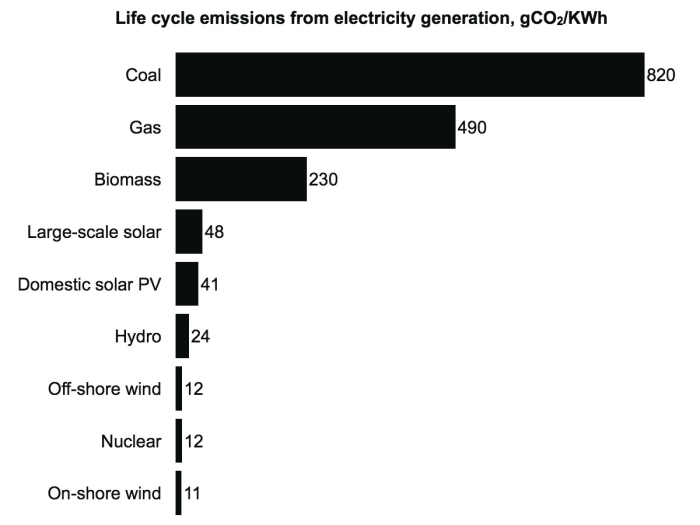
IPCC (2014) median estimates of life cycle carbon intensity of selected electricity sources. The figure includes mining, raw material and waste disposal impacts, but excludes infrastructure requirements such as energy storage, strengthened transmission grid, or backup generators. As a result, the figures are likely to underestimate emissions from variable sources such as wind and solar power.
To avert dangerous climate change, we will need lots and lots of low-carbon energy sources. Electricity is perhaps the most important of these, as it is wonderfully flexible form of energy that can replace fossil fuels in multiple applications. Furthermore, it is easy to deliver and we know how to generate it in quantity with very low carbon emissions.
Of all the methods of low-carbon electricity generation, nuclear power is still the single most important. It alone produces far more low-carbon electricity than all the “new” renewables combined. This is an inconvenient fact for those who try to oppose nuclear power while simultaneously opposing climate change. As a result, one hears constantly claims that nuclear power produces greenhouse gases – and that this makes it unsuitable for climate mitigation.
The first part of this claim is true: In fact, no energy source produces energy without greenhouse gas emissions of any kind. There are emissions associated with wind power, and there are emissions associated with solar power. The second part, the inference, is false, however. In all the serious research on the subject, the carbon balance of nuclear electricity is found to be very low. It compares well with wind power and, in fact, tends to be lower than that of solar electricity.
The most common counterargument we’ve heard at this point is the obvious: “Wait, what about uranium mining, or building of nuclear power plants? Surely they contribute a lot of emissions?”
Fortunately, we can say that this counterargument does not hold water. The figures quoted here, and in any serious scientific report, are so-called lifecycle emissions. This means that the figures already include impacts from mining, building of power plants, and so forth. In our opinion, it is somewhat insulting even to think that such obvious emission sources would not be included in any serious calculations.
But one thing that’s not included in these calculations is the additional infrastructure that is required to deliver equivalent level of service. For nuclear power plants, not much additional infrastructure is required, beyond obvious power lines. But if we want to deliver equivalent service – equivalent amount of reliable electricity generation – from variable sources, we most probably are going to need more infrastructure. This can be reinforced electricity grid to transfer energy from places where the wind blows or the sun shines to places where electricity is needed; it can be backup generators that provide power when it’s dark or calm; or it can be wind turbines and solar panels that are part of “overbuild” required to ensure that at least some catch the wind or the sun at all times.
So far, as the share of variable energy sources in electricity grid has remained small, this additional infrastructure is not really needed. The existing grid and existing power plants can cope with the limited variability, although this often incurs extra costs already. But as we expand our low-carbon energy production, we will need more and more infrastructure to cope with increasing variability. This causes both economic and environmental costs, resulting to higher carbon balance than these simple calculations would suggest.
This is one of the reasons why we believe that opposing proven solutions that can provide significant quantities of low-carbon energy is, at this point, a gamble with the climate. For more information, buy our book, Climate Gamble – or come to Paris during the COP21 climate negotiations and get one for free!
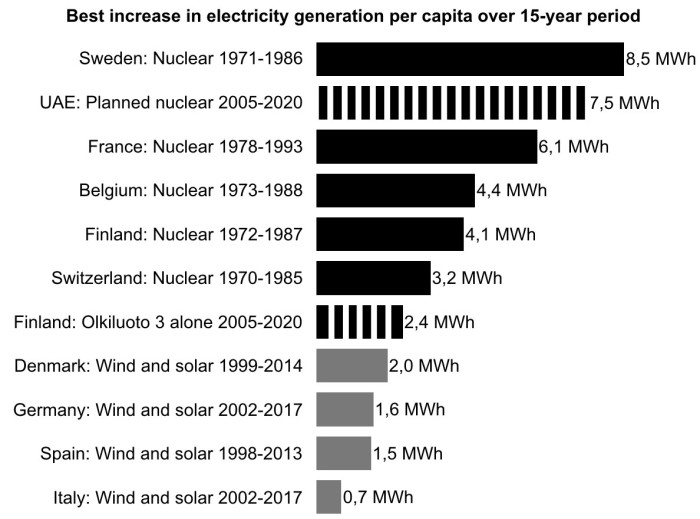
Greatest increases in low-carbon electricity generation over 15-year period, adjusted to account for population differences between countries. Data from BP Statistical Energy Review 2018.
NOTE: graph was updated to the latest data available 12th Jan 2019.
Even at this late hour, when we have mere 35 years to effectively end the burning of stuff for energy, there are some who argue against low-carbon energy generation. One of the more common arguments is that nuclear power plants take too long to build, and therefore they cannot help with the task.
This argument is patently false. While it may be true that building only nuclear may not be enough to stave off dangerous climate change, it is clear that nuclear is one of the best single technologies if we are really serious about combating climate change.
To wit, Exhibit A: historical long-term achievements of low-carbon energy, normalised to account for population differences. We used the widely available and generally reliable BP World Energy Outlook data to first search for the largest increase in low-carbon electricity generation over a 15-year window in each of the country covered; we then divided this increase with the average population of the country during the period.
As a result, we can see that nuclear power is surprisingly effective method for increasing low-carbon energy production. All the top spots in this graph belong to 1970s-80s era nuclear programs. Even the much-maligned Olkiluoto 3, the poster child of anti-nuclear movements worldwide, turns out to be faster than any attempt at wind and solar power combined.
Were we to normalise the results according to metrics that are even more relevant – gross domestic product (GDP) or purchasing power adjusted GDP per capita – nuclear power would look even better. The countries shown above succeeded in unprecedented and unequalled increase in low-carbon energy generation back in the day when they were much poorer than today, and significantly poorer than countries with high renewable energy ambitions. As the world’s poor continue to aspire for higher standards of living, this is an important point.
Of course, renewable installations have been growing fast. It is very possible, and very desirable, that some country will one day take the top spot in this chart with wind and solar installations combined. But it is not today; and we’re in a hurry.
One might also want to argue that the 15-year timescale is unfair: the largest increase in renewable energy has happened over the last decade or less. But decarbonisation is not a sprint, it is a marathon. Nuclear plants take time to plan and build, but permits and plans for renewable energy aren’t instantaneous either. We really need to take the long-term view; besides, had we selected the best five-year period (for example), nuclear energy would have won even more clearly.
All in all, we now need all the options at our disposal. At this point, anything else is a huge gamble with our climate.
Helsinki Climate March, 29th Nov 2015. Photo (c) Meela Leino. One Ecomodernist banner is visible on the right; another one was attacked, unfortunately.
Ecomodernists on the move. “Lisää ydinvoimaa” = “More nuclear power.” Photo (c) Meri-Tuuli Lauranto
Last Sunday, members of the Finnish Ecomodernist Society participated in the worldwide Climate March in Helsinki. This was probably the first time ecomodernists took part in a demonstration, and as such, a historical moment.
The ecomodernist message is clear: we need all the options at our disposal to stave off the climate crisis. This means, among other things, support for all low-carbon forms of energy, including nuclear power. With the future of our one habitable planet at risk, the stakes couldn’t be higher. Even though renewable energy is showing great promise, it and energy efficiency alone may not be enough. At minimum, we need an insurance policy, a “plan B,” in case the great…
Four countries, four histories of CO2 reductions. Data from World Bank and CDIAC carbon database.
In order to avoid dangerous climate change – a calamity that would disproportionately hit the world’s poorest and most vulnerable – we now need to reduce our greenhouse gas emissions at a rate exceeding 3 percent per year for the next 35 years or more. This is a monumental task, to put it mildly.
Given the stakes, the need, and the short time available, one would assume the world leaders would take a look at historically achieved emission reduction rates. However, evidence suggests this hasn’t been happening. How otherwise should we explain that climate discussions still raise Germany’s Energiewende policies to the pedestal, while completely ignoring those countries who have actually managed to reduce emissions at or nearly at the rates now required?
This graph, based on CDIAC carbon emission database and World Bank statistics, tracks the history of per capita emissions and identifies the best 10-year period of emission reductions. As you can see, in this historical light the achievements of that paragon of climate policies seem more like dismal failure than an example to be followed. At least three countries (as well as additional examples such as Switzerland) have accidentally implemented better climate policies than what the “best” climate policy so far has delivered. Two of these, France and Sweden, have produced at least 80 percent of their electricity from low-carbon sources since 1990. This 80 percent happens to be the goal Germany is striving for – by 2050! What’s more, these policies were enacted against a backdrop of rising electricity consumption per capita, whereas German policy relies on ambitious energy saving schemes coming to fruition.
In every field imaginable, it would be very bad news indeed if accident and chance repeatedly delivers better results than the “best” policy promoted. We need to raise our voices to ensure policy-makers stop burying their heads in sand and take a hard look at the measures that have actually and repeatedly been able to reduce emissions at rates now required. Anything else is a huge gamble with the climate and our living world.
For more information, get our book Climate Gamble, either from online stores or by coming to Paris during COP21 negotiations where we’re handing out nearly 5000 copies for free.
About five thousand free copies of Climate Gamble will be handed out to negotiators and activists gathering in Paris for the COP21 climate negotiations. The authors behind this independent book phenomenon on climate gamble and its solutions, Rauli Partanen and Janne M. Korhonen, collected funds for this unprecedented print run through non-profit crowdfunding campaign. The essential facts are as follows:
The book lays out the scale of climate challenge, as understood by most recent scientific studies, and the scope of solutions proposed to mitigate the dangers. Through IPCC and other studies, the book shows that mitigation plans that rely on renewable energy and energy efficiency alone are highly unlikely to succeed in time: we now need all the options, including nuclear power.
The book also shows how the global anti-nuclear movement has consistently twisted and misrepresented the facts and even resorted to fabricated statistics as it continues its 1980-era battle against nuclear energy – despite all the evidence that the 21st century sorely needs all low-carbon energy sources possible.
Non-profit crowfunding campaign collected enough money to print about 5000 books, which will be handed out free of charge to interested parties in Paris between 28th November and 12th December this year.
Taken together, the independently written and published book has sold nearly 8000 copies in Finnish and English. French and Czech translations are scheduled to appear in 2016 as well.
“Our goal is to promote science and evidence-based energy and climate policy, and bring out the fact that climate change mitigation is most likely more difficult, risky and expensive if we do not use all the tools at our disposal – including nuclear power,” says Janne M. Korhonen. “The anti-nuclear argumentation is largely based on unscientific claims, cherry-picked evidence and studious aversion to fair comparison between different alternatives. We’ve researched the subject for years, and also prepared a manuscript for a more comprehensive work detailing climate mitigation options available with nuclear power. This book is scheduled to be published in Finnish in early 2016.”
According to the two authors, it is obvious that if humanity wishes to prevent dangerous climate change, it cannot be too selective about the methods required. All the feasible solutions need to be considered, and nuclear power has track record of rapid, effective emission reductions. To act otherwise and limit solutions based on outdated, mostly unscientific preferences is a foolish gamble with the climate.
“The reception we’ve had for our book in Finland and elsewhere has been extremely positive. The Finnish edition of 2000 books has been nearly sold out in little more than half a year after publishing,” notes Rauli Partanen, who earns his living as an independent non-fiction author. “The international version will see French and Czech translations soon, and negotiations are underway for a Swedish version as well. This is extremely promising, particularly considering the fact that our book is self-published.”
In Paris, the duo will be distributing the books as well as taking part in several events either as speakers or in the audience. They will also take part in filming of a documentary, network with international energy and climate researchers and activists, and try to meet up with perhaps the most famous climate researcher of the world – Dr. James Hansen. Hansen, alongside with his three colleagues, Drs. Tom Wigley, Ken Caldeira and Kerry Emanuel, will be in Paris to deliver very similar tidings as Climate Gamble: mitigating dangerous climate change will almost certainly require radical expansion of not just renewable but also nuclear energy.
Like we wrote a while back, Climate Gamble will be published in French. Now we have more information on the matter, and a confirmation (in the form of publishing agreement signed).
Publication will be in March 2016.
Publisher will be EDP Sciences, a reputable academic publisher in France.
In addition to this, there will be a pre-run of the French version printed for COP21!
We will be giving a small presentation and signing the books at Nuclear for Climate -booth at La Galerie on Tuesday 8th December from 16:30pm onwards! We hope to see you there!
Top Climate Scientists Dr. James Hansen, Dr. Tom Wigley, Dr. Ken Caldeira and Dr. Kerry Emanuel to Issue Stark Challenge at Paris COP21 Climate Conference
The scientists will outline how only a combined strategy employing all the major sustainable clean energy options — including renewables and nuclear — can prevent the worst effects of climate change by 2100, such as the loss of coral reefs, severe damages from extreme weather events, and the destruction of biodiversity and ecosystems worldwide.
The challenge from the scientists comes as nuclear power is back on the table at Paris as a major climate mitigation option, appearing as a significant component of the Intended Nationally Determined Contributions (INDCs) of major emitters including China, the U.S. and India. The four scientists call for an increase in ambition in the deployment of improved light-water reactors, with the accelerated development of advanced fission technologies to accompany planned increases in solar, wind and hydro power generation.
In light of the urgency of tackling climate change and nuclear power’s essential role in limiting temperature rises, the four scientists will therefore challenge environmental leaders who still hold anti-nuclear positions to instead support development and deployment of safe and environmentally-friendly nuclear power.
We must say that it is great to be a small part of this process of getting evidence and science back to the climate policies of the world. This is very encouraging, and we sincerely hope that climate activists of all persuasions refuse to gamble with our climate any more, and start backing the science on the matter. It is the good, responsible and sensible thing to do. It is these paths we now choose that our grandchildren will judge us upon.
We are also very pleased to be attending various events with said top scientists during COP21. It should be highly interesting and very enlightening.
Top Climate Scientists Dr. James Hansen, Dr. Tom Wigley, Dr. Ken Caldeira and Dr. Kerry Emanuel to Issue Stark Challenge at Paris COP21 Climate Conference
Press Conference to take place on Thursday, December 3 at 14:00 in the Gallery of Solutions – Media Stage – Air and Space Museum, Paris, Le Bourget
Dr. James Hansen, Dr. Tom Wigley, Dr. Ken Caldeira and Dr. Kerry Emanuel will present research showing the increasing urgency of fully decarbonizing the world economy. However, they will also show that renewables alone cannot realistically meet the goal of limiting global warming to 2 degrees C, and that a major expansion of nuclear power is essential to avoid dangerous anthropogenic interference with the climate system this century. (1)
The scientists will outline how only a combined strategy employing all the major sustainable clean energy options — including renewables and nuclear — can prevent the worst effects of climate change by 2100, such as the loss of coral reefs, severe damages from extreme weather events, and the destruction of biodiversity and ecosystems worldwide.
The challenge from the scientists comes as nuclear power is back on the table at Paris as a major climate mitigation option, appearing as a significant component of the Intended Nationally Determined Contributions (INDCs) of major emitters including China, the U.S. and India. The four scientists call for an increase in ambition in the deployment of improved light-water reactors, with the accelerated development of advanced fission technologies to accompany planned increases in solar, wind and hydro power generation.
In light of the urgency of tackling climate change and nuclear power’s essential role in limiting temperature rises, the four scientists will therefore challenge environmental leaders who still hold anti-nuclear positions to instead support development and deployment of safe and environmentally-friendly nuclear power. For example, the Climate Action Network, representing all the major environmental groups, still insists despite all evidence to the contrary that “nuclear has no role to play in a fully decarbonized power sector.” The four scientists will state that the anti-nuclear position of these environmental leaders is in fact causing unnecessary and severe harm to the environment and to the future of young people.
The scientists will outline the latest research on sea level rise, ocean acidification and ice sheet collapse supporting their conclusions about the increased urgency of tackling carbon emissions.
Dr. Hansen will brief journalists on his latest collaborative modelling and paleoclimate work, concluding that even 2C of global warming is “highly dangerous” and could lead to non-linear disintegration of ice sheets, ocean stratification and multi-meter sea level rise even within this century.
The four presenting climate scientists are each leading pioneers in the field of climate and atmospheric science, having made major contributions to our understanding of climate change. Dr. James Hansen is a professor at the Department of Earth and Environmental Sciences at Columbia University and former head of the NASA Goddard Institute for Space Studies, Dr. Kerry Emanuel is a professor of atmospheric science at Massachusetts Institute of Technology, Dr.Tom Wigley is a climate scientist at the University of Adelaide and Dr.Ken Caldeira is a climate scientist at the Carnegie Institution for Science, and at the Stanford University Department of Earth System Science. For brief biographies, please see below.
The lead speaker at the press conference, Dr. James Hansen, is widely regarded as having been the first to raise the alarm about climate change, more than 25 years ago.
Press Conference at Paris UNFCC COP21
Dr. James Hansen, Dr. Tom Wigley, Dr. Ken Caldeira & Dr. Kerry Emanuel
Thursday, December 3 at 14:00
Gallery of Solutions – Media Stage – Air and Space Museum, Paris, Le Bourget
Media may RSVP to: Paris@jmpverdant.com
Biographies
James Edward Hansen is an American professor at the Columbia University Earth Institute. Hansen is best known for his research in the field of climatology, his testimony on climate change to congressional committees in 1988 that helped raise broad awareness of global warming, and his advocacy of action to avoid dangerous climate change. In recent years, Hansen has become a climate activist for action to mitigate the effects of climate change, which on a few occasions has led to his arrest. From 1981 to 2013, he was the head of the NASA Goddard Institute for Space Studies in New York City. As of 2014, Hansen directs the Program on Climate Science, Awareness and Solutions at Columbia University’s Earth Institute. The program is working to continue to “connect the dots” from advancing basic climate science to promoting public awareness to advocating policy actions.
Tom Wigley is a climate scientist with the University of Adelaide and the National Center for Atmospheric Research. He was named a fellow of the American Association for the Advancement of Sciences (AAAS) for his major contributions to climate and carbon cycle modeling and to climate data analysis, and because he is “one of the world’s foremost experts on climate change and one of the most highly cited scientists in the discipline.” He has contributed to many of the reports published by the Intergovernmental Panel on Climate Change (the work of the IPCC, including the contributions of many scientists, was recognized by the joint award of the 2007 Nobel Peace Prize).
Ken Caldeira is a climate scientist at the Carnegie Institution for Science, where his job is “to make important scientific discoveries.” He also serves as a Professor (by courtesy) in the Stanford University Department of Earth System Science. Caldeira is a member of the committee producing the 2015 U.S. National Academy of Sciences report “Geoengineering Climate: Technical Evaluation and Discussion of Impacts.” He is also a contributing author to the Intergovernmental Panel on Climate Change (IPCC) AR5 report Climate Change 2013: The Physical Science Basis. In 2010, he was a co-author of the 2010 US National Academy America’s Climate Choices report and was elected Fellow of the American Geophysical Union. He participated in the UK Royal Society geoengineering panel in 2009 and ocean acidification panel in 2005. Caldeira was coordinating lead author of the oceans chapter for the 2005 IPCC report on Carbon Capture and Storage.
Kerry Emanuel is an American professor of atmospheric science at Massachusetts Institute of Technology. In particular he has specialized in atmospheric convection and the mechanisms acting to intensify hurricanes. He is the author or co-author of over 100 peer-reviewed scientific papers, and two books, including Divine Wind: The History and Science of Hurricanes, recently released by Oxford University Press and aimed at a general audience, and What We Know about Climate Change, published by the MIT Press. He was named one of the Time 100 influential people of 2006. In 2007, he was elected as a member of the United States National Academy of Sciences.
(1) Nearly every serious look at the energy technology required over the next several decades to supply the world’s growing energy appetite while effectively mitigating climate change has concluded that there is likely to be a need for large amounts of nuclear energy. In 2014 alone, reports from the Intergovernmental Panel on Climate Change, the International Energy Agency, the UN Sustainable Solutions Network and the Global Commission on the Economy and Climate argued for a doubling or trebling of nuclear energy – requiring as many as 1,000 new reactors or more in view of scheduled retirements – to stabilize carbon emissions e.g. Intergovernmental Panel on Climate Change, Working Group III – Mitigation of Climate Change, http://www.ipcc.ch/report/ar5/wg3/, Presentation, slides 32-33; International Energy Agency, World Energy Outlook 2014, p. 396; UN Sustainable Solutions Network, “Pathways to Deep Decarbonization” (July 2014), at page 33; Global Commission on the Economy and Climate, “Better Growth, Better Climate: The New Climate Economy Report” (September 2014), Figure 5 at page 26.



 Helsinki Climate March, 29th Nov 2015. Photo (c) Meela Leino. One Ecomodernist banner is visible on the right; another one was attacked, unfortunately.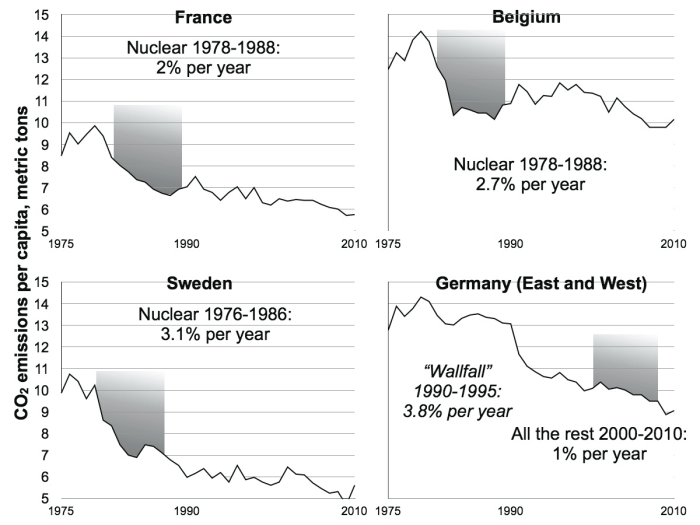
 Like we wrote a
  Climate Gamble