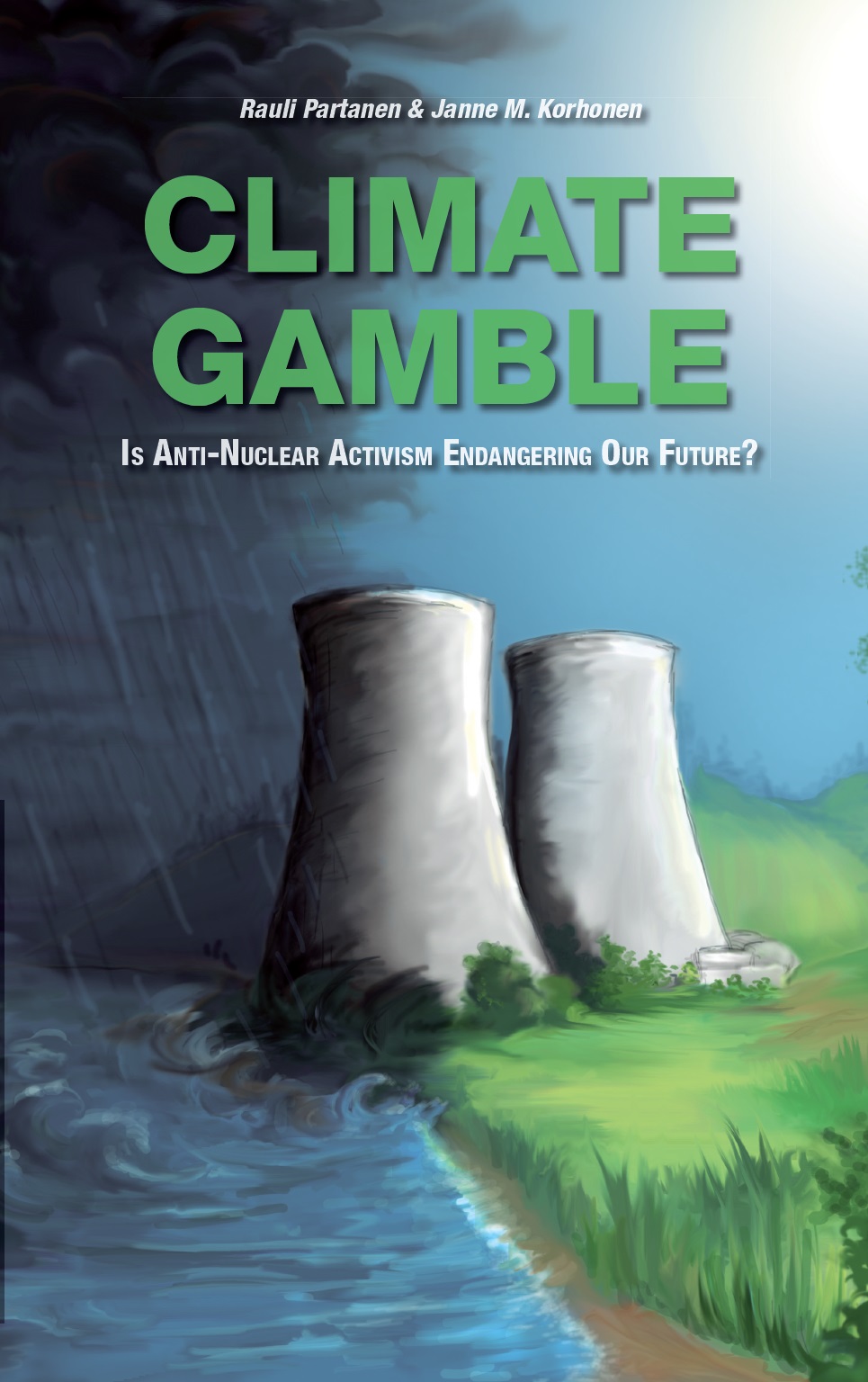
We are very pleased and excited to announce that Prof. David MacKay wrote the foreword for our latest edition of Climate Gamble, which we will be distributing in COP21 climate negotiations in Paris (as part of our campaign).
David MacKay, for us, is a champion for evidence-based policy and fact-based energy discussion. His ground-breaking book Sustainable Energy – Without the Hot Air (free pdf) has been a very big inspiration to both of us, and one of key books that lead to writing Climate Gamble. He is also the Former Chief Scientific Advisor, Department of Energy and Climate Change in the UK, and has numerous other distinctions as well.
So we are very, very pleased to add “Wrote a splendid foreword for Climate Gamble – Is Anti-Nuclear Activism Endangering Our Future” to his CV, if he has not yet already done so. 😉
We are just finalizing a contract with a respected French publisher for translating and publishing Climate Gamble. The translation is almost finished already.
Did we tell you how marvelous this is? 🙂
Anyway, stay tuned, we will let you know more (and there IS more) when the contract is signed!
Land use of equivalent wind and nuclear power generation (ca. 27 terawatt hours per year). Examples are Olkiluoto nuclear power plant and Onkalo waste repository (Finland) with Ranger uranium mine (Australia), and a composite graphic based on Oosinselkä wind farm (3 MW turbines). Maps are to scale and include only essential roads and power connections.
Besides climate change, one of the major environmental problems of our age is biodiversity loss. As it is caused largely by increased human land use, stopping biodiversity loss requires us to reduce the land footprint of humanity.
A major problem with renewable-heavy or renewable-only energy scenarios is that they essentially do not acknowledge any problem with human land use. In these visions, vast areas are to be dotted with wind turbines, filled with solar panels or (perhaps most problematically) used for biofuel production to produce enough energy and to deal with intermittency of stochastic energy sources: if you’ve ever heard the explanation “it’s always windy somewhere,” you’ve heard a call to build two to five times as many wind turbines as their nominal production would suggest.
Compared to wind, solar and biomass farms of the required scale, the environmental footprint of nuclear energy is very small. The graph above attempts to show this difference, based on real-world projects in Finland (and an Australian uranium mine). Note that this is for similar annual production of about 27 terawatt hours: to produce energy of similar quality – that is, non-intermittent – one would probably require at least three wind farms of equal size, spaced far enough apart, or significant energy storage facilities.
Note also that the figure likely overestimates nuclear land use. The Olkiluoto plant contains a reserved area for fourth reactor, capable of increasing the annual production from same land area by as much as 13 TWh; and the Ranger uranium mine could easily supply many more reactors.
We would like to emphasize that this picture should not be construed as an argument against wind power or other renewables. We almost certainly need all the low-carbon energy we can have, and both wind and solar have, on the whole, much lower environmental footprint than fossil fuels. The only reason we publish this image is to show that the oft-stated claim of nuclear energy’s environmental destructiveness is misleading at best, and outright falsehood at worst.
This series of posts introduces graphics from our book Climate Gamble: Is Anti-Nuclear Activism Endangering Our Future? The book is now available on Amazon.com in Kindle and paperback formats; see also our crowdfunding initiative which aims to deliver a copy of the book to COP21 climate delegates in Paris this December.
Big thanks to everyone who contributed to our indiegogo-campaign or bought books directly from us so far.
Thanks to you, we now have enough money to be able to go to Paris, print at least a dozen boxes of books, and distribute them there. We have the lodging there already booked.
This is GREAT!
Of course, we would like to have as much to do while there as possible. We would like to have a hundred boxes of books. There are thousands upon thousands of participants and other people at COP21 to whom we would love to give a free copy. Also, if we make enough waves, maybe the media will take some interest in the matter.
In short, this is just the first milestone. We need to keep our eye on the target: Get as many books as possible to Paris. Help us to help save the world with independent research and evidence based policy. Participate in our campaign now!
Renewable energy installations (nameplate capacity) have recently even declined, long before the build rates required for decarbonization have been achieved. Particularly worrying is the sharp decline in solar PV installations in Europe. Sources: EPIA & GWEC.
The previous weekly pic introduced the calculations of Loftus et al. (2015), which show that decarbonization scenarios that do not allow nuclear energy require stunning, unprecedented rates of new clean energy installations. Even though the popular press is today awash with news of renewable energy achievements, these required rates are still far away. More ominously, there are some indications that the rate of increase in renewable energy installations may be slowing down, perhaps even stalling.
The most prominent example comes from solar PV installations in Europe. Compared to peak in 2011, new solar PV generation capacity is being installed far slower. Subsidies have dried up, and although installations still continue, the major problem is that the rate is far from what’s required for decarbonizing the economy. Furthermore, as solar panels (and other energy generators) inevitably age and need to be replaced, the rate of new capacity addition soon needs to increase even further, simply to replace retiring generation.
It is more than likely that the installation rates will increase from the lows presented here. Nevertheless, one needs to remember the previous post’s message: if we want to decarbonize without nuclear power, we need absolutely huge increases from current installation rates. It bodes ill for the prospects of these rates being achieved that these hiccups occur already, when solar and wind together still provide less energy to the world than nuclear power alone.
Nevertheless, some members of our society still think the required increases in renewable installations and energy savings rates are done deal, and that we can forget about nuclear power entirely. These graphs point out again that this stance is a huge gamble with the climate.
This series of posts introduces graphics from our book Climate Gamble: Is Anti-Nuclear Activism Endangering Our Future? The book is now available on Amazon.com in Kindle and paperback formats; see also our crowdfunding initiative which aims to deliver a copy of the book to COP21 climate delegates in Paris this December.
Required new energy generation build rates and sustained annual energy efficiency improvements in different climate mitigation scenarios, and historical record rates. Source: Loftus, P. J., Cohen, A. M., Long, J. C. S., & Jenkins, J. D. (2015). A critical review of global decarbonization scenarios: what do they tell us about feasibility? Wiley Interdisciplinary Reviews: Climate Change, 6(1), 93–112. doi:10.1002/wcc.324
In the previous two posts, we showed with IPCC data how the climate mitigation scenarios proffered by anti-nuclear groups are based on extreme optimism on not just one but two counts: they assume that renewables will grow at least as fast as, and that energy demand increase can be checked at least as well, as the most optimistic IPCC projections allow. Generally speaking, if the plan depends on not just one but two factors developing according to the most optimistic assumptions, one might want to have a different plan – especially if at the stake is the future of our only habitable planet.
But how much are these plans assuming, in fact? This important question is partially answered in a recent study by Loftus et al. (2015), which examined 17 widely publicized global decarbonization scenarios. These included three scenarios (from World Watch, Greenpeace, and Stanford professor Mark Jacobson et al.) that explicitly attempted to stabilize the climate without nuclear energy – relying solely on energy efficiency, renewables, and fossil fuels.
The key results are summarized to the graphic above, and compared to short term, historically achieved records (that is, the best single year ever). For renewable only scenarios, energy efficiency needs to improve every year almost twice as fast as has been achieved in the best year in record. Simultaneously, new (renewable) energy generation must be built 1.4 to 15 times (!) faster than new energy generation from all sources together has been ever added in a single year – and this build rate must be sustained for decades.
Succeeding in either one of these alone would be a monumental undertaking. Succeeding at the both at the same time may be technically possible, but it is most certainly a gamble – a Climate Gamble.
This series of posts introduces graphics from our book Climate Gamble: Is Anti-Nuclear Activism Endangering Our Future? The book is now available on Amazon.com in Kindle and paperback formats; see also our crowdfunding initiative which aims to deliver a copy of the book to COP21 climate delegates in Paris this December.
References
Loftus, P. J., Cohen, A. M., Long, J. C. S., & Jenkins, J. D. (2015). A critical review of global decarbonization scenarios: what do they tell us about feasibility? Wiley Interdisciplinary Reviews: Climate Change, 6(1), 93–112. doi:10.1002/wcc.324
Sources: IPCC (2011): SRREN, Figure 10.2, and IPCC (2014): AR5 WG3: Mitigation of Climate Change, Chapter 7: “Energy Systems,” p. 561.
In prior installment of our posts introducing the graphics from our book Climate Gamble: is Anti-Nuclear Activism Endangering Our Future?, we showed how the IPCC special report on renewable energy potential actually shows that most scenarios fall far short from supplying the world with enough low-carbon energy in 2050. This picture expands upon the SRREN results by showing IPCC’s latest estimates of world energy demand up to 2050.
IPCC estimates that even if powerful climate mitigation policies are adopted around the world, the world energy demand will most likely be at least 450 exajoules per year (EJ/a), and may be as much as 800 EJ/a. If climate policies are neglected as they are now, the final energy use may be much higher. Since even the highest single outlier in IPCC’s SRREN report forecasts renewable energy potential to be at most 428 EJ/a, we have a major problem.
In short, the non-nuclear energy scenarios rely on two things: that renewables will at the very least succeed as well as the most optimistic of 164 IPCC SRREN energy scenarios suggests; and that energy saving measures will succeed at the very least as well as the most optimistic of IPCC’s energy demand scenarios suggests. (The next week’s installment will explain in more detail what these scenarios demand in practice.) If either one fails to deliver as planned yet alternatives cannot be deployed, we are in deep trouble. Your mileage may vary, but we feel that such optimism amounts to a reckless gamble, as we do not have a planet or plan B to fall back on.
This series of posts introduces graphics from our book Climate Gamble: Is Anti-Nuclear Activism Endangering Our Future? The book is now available on Amazon.com in Kindle and paperback formats; see also our crowdfunding initiative which aims to deliver a copy of the book to COP21 climate delegates in Paris this December.
We are happy to announce our greatest endeavour ever!
We have been gathering steam, making new contacts, planning and preparing for months.
Now we are launching our most ambitious crowd-funding campaign ever. We aim to deliver thousands of our book to participants in the COP21 climate negotiations, held in Paris in December this year!
From what we have learned, there are some big gaps in the knowledge of the negotiators on several issues regarding mitigating climate change. These include:
The science on the realities of the needed decarbonization efforts; several percent each year for decades to come in most western nations.
The consensus on the best, and the most likely, speed with which we could build renewable energy production and increase efficiency, and if this can be matched with the needed rate of decarbonization with any likelyhood of success (it cannot).
The IPCC’s conclusion on the carbon balances of various energy sources, namely the fact that nuclear is very low carbon, and that biomass is not necessarily low carbon.
The consensus of various organizations, IPCC and IEA included, on the absolute necessity that we use all available tools – including nuclear energy, renewables, efficiency, conservation and carbon capture and storage – to mitigate climate change if we are to have any practical chance to avert catastrophic consequences.
And much, much more.
We are also very, very sad about the fact that several groups that call themselves environmentalists, are actively, even forcefully campaigning against the scientific consensus on the matter. They would like to see nuclear excluded from our toolbox of mitigating climate change. According to scientific consensus, this is a certain road to disaster.
We need all the tools. Help us spread this message. Participate in our campaign, spread infromation about it.
Sources: IPCC SRREN (2011), Figure 10.4, and IPCC AR5 WG3 Draft (2014), p. 66.
By 2050, Earth will be home to nine to ten billion people. Most of those people will aspire to a higher standard of living, and in poor countries, this will mean more demand for energy supplies. Meanwhile, the raw material deposits the industrialized economy is dependent upon are diminishing in quality, and extracting useful materials will require far more energy inputs. Furthermore, fossil fuels need to be replaced with cleaner alternatives, and since this in many cases involves inherently inefficient conversion processes (for example, pyrolyzing biomass to liquid fuel), the demand for primary energy supplies in these applications will likely rise.
For these and other reasons, almost every serious estimate of the future of world energy demand concludes that the demand will at the very least stay close to current figures, and most likely it will rise substantially. The intergovernmental panel on climate change, IPCC, estimates that even if climate mitigation is taken seriously – which is currently not the case – the world energy demand is likely to rise. A range of scenarios illustrated above trends towards 600 to 700 exajoules per year, and possibly more. If, on the other hand, climate change is approached with the current leisurely fashion, energy demand in 2050 could be much higher: quite possibly as much as 1500 exajoules per year.
You can therefore understand our horror when we realized that the report many environmental organizations lauded as the “most comprehensive” report on the renewable potential so far falls very short of these goals. The report in question, IPCC’s Special Report on Renewable Energy Sources and Climate Change Mitigation or SRREN for short, assessed 164 energy scenarios derived from 16 distinct models. The report was by no means overly critical of renewables; nevertheless, its conclusions are sobering. The most positive outlier scenario out of 164 could perhaps deliver 428 exajoules per year in 2050; the average of all 164 scenarios is just 186 exajoules.
If something goes wrong in either the most positive outlier scenario or in the lower estimates for world energy use, the outcome is clear: the climate is done for. Even 100 exajoules per year from unabated fossil fuel burning would probably be too much, and cause us to fail in our climate goals.
And if anything unexpected happens either with energy demand or with renewable scenarios, the gap between what is needed and what is delivered can be huge.
Yet all this is almost never even mentioned in public discourse. Powerful non-governmental organizations act as if these estimates didn’t even exist, and continue to imply that we could easily power the entire planet with renewables alone. In effect, they act as if the most optimistic outlier in the most comprehensive report to date is something of a “worst case” scenario for renewables, to be easily exceeded when needed.
We believe this to be a huge gamble with our stable climate. At the very least, it is hard to call it responsible policy.
This series of posts introduces graphics from our book Climate Gamble: Is Anti-Nuclear Activism Endangering Our Future? The book is now available on Amazon.com in Kindle and paperback formats; see also our crowdfunding initiative which aims to deliver a copy of the book to COP21 climate delegates in Paris this December.
 We are very pleased and excited to announce that Prof. David MacKay wrote the foreword for our latest edition of Climate Gamble, which we will be distributing in COP21 climate negotiations in Paris (as part of our campaign).


 Climate Gamble